



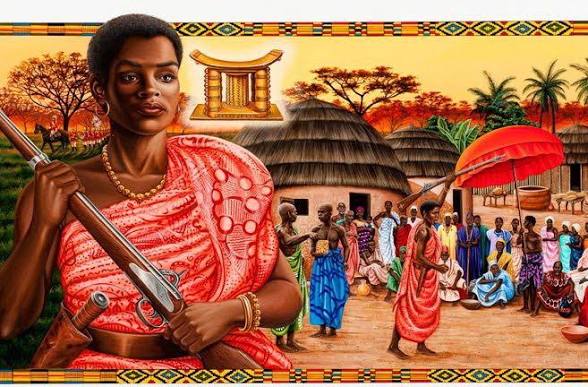

“Sɛ ɔbaa tuu ɔbarima foɔ a, ɔde ne ho bɔ ohene.”
If a woman gives advice to a man, she aligns herself with the king.
There is a particular kind of silence that falls over a room when tradition is being broken, not with a crash but with the quiet, undeniable force of necessity. This Akan proverb speaks directly into that silence. It describes a woman who looks around at the men who were supposed to lead, sees that their fire has guttered out or their will has collapsed, and decides that she will not let the kingdom fall simply because the expected hands have fallen limp. She steps into a space that custom did not carve out for her, and she does it without asking for permission because the situation itself has issued the only permission that matters. And in that single act of stepping forward, she earns something that no stool, no title, and no ceremony could ever bestow on its own. She becomes a king, not in name but in substance.
This is the story of Nana Yaa Asantewaa, the Queen Mother of Ejisu, and it is a story that has been told to every Ghanaian child in every classroom across the country. But somewhere between the chalk dust and the examination questions, the living breath of the story often gets lost. We remember the name and the basic outline, but we forget that this is not merely a history lesson. It is a field manual for what it means to lead when the cost of leadership is everything you have.
The Stool and the Insult
To understand what Yaa Asantewaa did, you have to understand what the British did first, and to understand that, you have to understand what the Golden Stool actually meant to the Ashanti people. This was not a throne in the European sense, a gilded chair that symbolized power because everyone agreed it symbolized power. The Golden Stool, Sika Dwa Kofi, was understood to contain the very soul of the Ashanti nation. It was the living embodiment of the collective spirit of a people, past, present, and yet to be born. To threaten the stool was not to threaten a piece of furniture. It was to threaten the spiritual annihilation of an entire civilization.
By the year 1900, the Ashanti Empire had already been battered by decades of conflict with the British, and the great Asantehene, Prempeh I, had been captured and sent into exile in the Seychelles four years earlier. Before they took him, Prempeh had given one final, absolute instruction to those who remained: the Golden Stool must never, under any circumstances, fall into British hands. It was hidden so carefully that only a handful of trusted souls knew where it rested. The Ashanti had lost their king, yes, but they had managed to keep their soul, burying it like a seed in the earth to wait for a safer season.
Then came Sir Frederick Hodgson, the British Governor of the Gold Coast, and he walked into Kumasi with all the swagger of a man who had mistaken a map for the territory itself. He summoned the Ashanti chiefs to a meeting, and when they had gathered, he made a demand so astonishing in its ignorance that it still has the power to take your breath away more than a century later. He announced that since he represented Her Majesty the Queen of England, the paramount power, it was only proper that he should be given the Golden Stool so that he might sit upon it.
A silence fell over that room, the kind of silence that is so thick and so absolute you can almost hear the ancestors holding their breath. The chiefs were not merely offended; they were looking at a man who had just committed spiritual desecration without even understanding the vocabulary of the religion he was defiling. And yet, their first instinct, battered and weary as they were, was not to fight. It was to negotiate. It was to appease. They were afraid, and their fear was entirely reasonable. They had seen what the British could do, and they wanted to find a path, any path, that did not end in more graves.
The Fire That Was Not Extinguished
When the chiefs returned to their villages, the mood was one of heavy, suffocating despair. A secret meeting was convened in Kumasi, and the conversation that unfolded was not about whether to resist but about how to submit with the least possible pain. The great warrior spirit of the Ashanti, which had built an empire and defied colonizers for generations, seemed to have been buried in the same grave as Prempeh’s freedom.
Yaa Asantewaa was there. She was the Queen Mother of Ejisu, which meant that her formal role was to advise, to guide, to be the keeper of custom and the caretaker of her grandson’s stool. She was not a military commander. She was not expected to speak on matters of war unless asked. She sat and listened to the men around her, men she had known her whole life, speak the language of fear and surrender. And then, unable to contain the fire that was burning in her chest any longer, she stood up.
The exact words vary depending on which elder is telling the story, but the substance has been carved into our national memory. She looked at the gathered chiefs, these warriors and leaders, and she asked them, in effect, whether it was true that the Ashanti were no longer men. She told them that she would not pay a single penny to the British. And then she delivered the line that cracked history open. If the men of Ashanti would not go forward to fight, then she would call upon her fellow women, and they would fight. They would fight until the last of them fell on the battlefield.
Then she did something that transformed her words into a ritual. She removed her headscarf. She removed her sandals. In Ashanti custom, for a woman of her stature to remove her headscarf in public was an act of either ultimate grief or a powerful curse upon the shame of those who had failed in their duty. She was not making a suggestion or offering an opinion. She was issuing a verdict, and the verdict was that the men in that room had to choose, right then, between reclaiming their honor or losing it forever. Pick up the gun, her actions said, or surrender any claim you ever had to the name of an Ashanti warrior.
She was sixty years old. She put on the batakari, the war smock, and she did not ask anyone for permission to do so. She claimed the right to defend her people because no one else was claiming it, and in that vacuum of leadership, her moral authority became the only authority that mattered.
The Leadership Lessons of Yaa Asantewaa
It would be easy to remember this moment as a flash of theatrical brilliance, a grandmother shaming the men into action with a clever bit of cultural theater. But Yaa Asantewaa was not an actress playing a part. She was a leader who understood, at a profound and instinctive level, exactly what her people needed to hear and see in order to move from paralysis to action. Her actions provide a masterclass in crisis leadership that is as urgently relevant in a twenty first century boardroom or community organization as it was in a 1900 war camp.
- She Knew That Dignity Was the Real Asset
The British wanted the stool. They wanted the land and the gold and the submission. But Yaa Asantewaa understood something that the chiefs, in their exhaustion, had momentarily forgotten: if the Ashanti surrendered their dignity, their willingness to be shamed, then everything else would be lost eventually anyway. You can survive a bad quarter in business. You can survive a competitive threat or a public scandal. But if your people lose their sense of identity, their belief that who they are and what they stand for is worth protecting, then the organization, the community, the nation is already dead, and it just hasn’t stopped breathing yet. She went to war not for territory or tribute, but for the soul of her people. A leader who can name and defend the soul of an organization can rally people to endure almost anything.
- She Led from Moral Authority, Not Formal Title
Yaa Asantewaa was a Queen Mother. In the ordinary course of events, her power was exercised through counsel, through influence, through the quiet, persistent shaping of decisions behind the scenes. But when the formal leadership structure, the chiefs who were supposed to make these decisions, froze in the headlights of an impossible choice, she did not stage a coup or claim a title that was not hers. She simply stepped into the gap. She led from the position she already had, leveraging the moral authority she had spent a lifetime earning. This is a crucial lesson for anyone who believes they need a promotion, a new title, or formal permission before they can make a difference. If you see a crisis unfolding and you have the insight and the courage to speak, you are already a leader. Your email signature has nothing to do with it.
- She Used Shame as a Strategic Instrument
This is a delicate and culturally specific lesson, but it is one of the most powerful tools in her arsenal. Yaa Asantewaa knew the men in that room. She knew that appealing to their fear would not work because fear was the very thing that had them paralyzed. She had to activate a deeper and more primal emotion: the terror of dishonor. By offering to go to war herself, she held up a mirror that forced them to see their own inaction for what it was. In leadership, there are times when you cannot simply encourage people toward a better future; you must make the present so uncomfortable, so viscerally unacceptable, that staying where they are becomes more painful than moving forward into the unknown. Her genius was making inaction feel more dangerous than battle.
- She Spoke When the Room Had Fallen Silent
Picture that meeting in Kumasi again. The great chiefs of the Ashanti Empire, men who had led armies and negotiated with foreign powers, are sitting in a circle, and no one is speaking. The weight of the decision is so heavy that it has crushed every voice in the room. And into that vacuum of silence steps a sixty year old grandmother who has had enough. She did not have the loudest voice in the room. She had the only voice that mattered in that moment because it was the only voice speaking truth. One person, speaking with clarity and unshakeable conviction, altered the trajectory of Ashanti history. You do not need to be the highest ranking person in the room to speak. You do not need an invitation. If you can see what no one else is willing to name, the floor is already yours.
- She Paid the Full Price for a Harvest She Knew She Would Never See
This is the part of the story we tend to rush past, eager to get to the inspiration without dwelling on the cost. The War of the Golden Stool, which history now rightly calls the Yaa Asantewaa War, raged for several months. The Ashanti fought with extraordinary courage and ingenuity, building stockades and using the forest itself as a weapon. But British firepower was overwhelming. Yaa Asantewaa was eventually captured. She was not executed, but she was sent into exile, joining Prempeh I in the Seychelles. She died there in 1921, thousands of miles from the forest soil she had risen to defend, never having seen the Golden Stool restored to its rightful place or her people breathe the air of freedom.
But here is the lesson that is easy to miss because it requires us to think on a timescale that modern life discourages. Yaa Asantewaa did not fight for a victory she expected to hold in her own hands. She planted a tree whose shade was meant for her grandchildren, for you and for me, not for herself. This is the most demanding form of leadership there is. It is relatively easy to fight when the reward is visible on the horizon. It requires a different order of courage entirely to fight when your only reward is the fragile hope that someone you will never meet might one day sit under a tree you watered with your own exile and your own blood. The Golden Stool was never captured. Prempeh I was eventually allowed to return. And the ashes of Yaa Asantewaa were brought home to rest in the soil she had refused to surrender. She won, even though she died long before the victory parade.
The Proverb Realized
When Yaa Asantewaa rose to her feet and spoke, she was not trying to seize power or claim a throne. She was trying, with every fiber of her being, to wake up the kings who were sitting around her, frozen in their fear. But in the act of putting on the batakari and declaring that she herself would march into the fire if no one else would, she stepped into the ancient truth of the proverb with which we began. When a woman fires a gun for a man, she has made herself a king.
In the eyes of her people, and in the unblinking judgment of history, she became an Osahene, a warrior leader of the highest order. Not because she campaigned for the title or demanded recognition, but because she shouldered a weight that would have crushed anyone who was not anchored to something eternal. She wore the war pants not to humiliate the men around her but to save the nation that all of them loved. And in saving it, she transcended every category that had previously defined her.
What Will You Defend?
The odds are very good that you will never have to face down a colonial governor or rally an army with nothing but your voice and your conviction. But you will face moments, perhaps you are facing one right now, when the culture of your team is being eroded, when the integrity of your organization is being traded away for short term comfort, or when the dignity of your community is under quiet, persistent assault. You will sit in meetings where everyone in the room knows what is wrong but no one is willing to be the first to name it.
The question that Yaa Asantewaa’s life asks of you, across more than a hundred years of history, is not whether you are strong enough or senior enough or brave enough. The question is simpler and far more terrifying than that. It is this: Will you remain seated in the silence, or will you stand up and put on the war pants?
There is a Golden Stool in your own life. It might be your values, your vision, your people, or a project that you know in your bones is worth fighting for. It is waiting for someone to defend it.
Why not you?



Leave a Reply
You must be logged in to post a comment.