



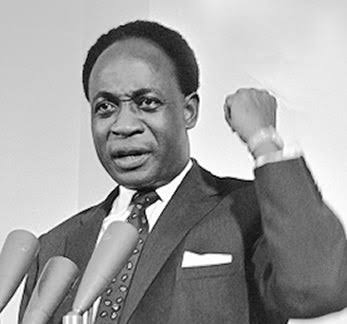

“Forward ever, backward never.”
There are phrases that become so familiar, so worn by repetition, that we forget they were once spoken into existence by a single human voice in a specific moment of history. This phrase, which has become a national mantra emblazoned on everything from school walls to political banners, was not always a slogan. It was a declaration. It was a philosophy. It was the distillation of a man’s entire life into four words that left no room for retreat.
That man was Osagyefo Dr. Kwame Nkrumah, the first prime minister and president of Ghana, the man who led the first sub-Saharan African nation to independence and then spent the rest of his life trying to convince an entire continent that its freedom was meaningless unless it was shared.
We know the broad strokes of his story because we were taught them in school. The independence declaration at the Old Polo Ground. The vision of Pan-Africanism. The overthrow in 1966. But the broad strokes do not capture the texture of the man: the restless student who worked menial jobs in America while devouring books on revolution, the organizer who built a mass political party from nothing, the leader who made mistakes so large they eventually consumed him. To understand Nkrumah is to understand both the soaring possibility and the sobering complexity of leadership. His life is not a simple morality tale. It is a mirror in which we can see our own ambitions, our own blind spots, and our own responsibility to a vision larger than ourselves.
The Gold Coast Boy Who Refused to Stay Put
Kwame Nkrumah was born Francis Nwia-Kofi Ngonloma on September 21, 1909, in the small village of Nkroful in the Western Region of what was then the British Gold Coast. His father was a goldsmith, his mother a retail trader, and his earliest education came at the hands of Catholic missionaries in nearby Half Assini. By any measure, he was born into modest circumstances in a colonized land where the ceiling for African ambition was low and firmly fixed.
But there was something in him that refused to accept the dimensions of the box that history had built around him. After obtaining his teacher’s certificate from Achimota College in 1930 and spending several years teaching in Catholic schools along the coast, he made a decision that would alter not only his own trajectory but the trajectory of an entire continent. In 1935, with little money and no guarantees, he sailed for the United States to pursue an education.
The America he encountered was not the America of glossy opportunity. He was a Black man in a deeply segregated society, working menial jobs: dishwasher, waiter, laborer, to support himself while studying. But he was also a young man whose mind was on fire. At Lincoln University, the first historically Black university in the United States, and later at the University of Pennsylvania, he immersed himself in economics, sociology, theology, and philosophy. He read Marx and Lenin, but he also read Marcus Garvey, the Jamaican Black nationalist whose call for African redemption and self-reliance struck a chord that would resonate for the rest of his life. By the time he left America in 1945, he had earned multiple degrees and, more importantly, had forged an intellectual framework that fused socialism, nationalism, and a fierce belief in the dignity and capacity of African peoples.
He did not go home immediately. He went to London, where the postwar air was thick with anti-colonial ferment. There he met George Padmore, the Trinidadian radical who became his mentor, and together they organized the Fifth Pan-African Congress in Manchester in 1945. The congress brought together activists, students, and workers from across the African diaspora, and it issued a declaration that was nothing short of revolutionary: independence for African colonies, not in some distant future, but now. Nkrumah later wrote that Manchester “fired me with a new sense of mission.” He was ready to go home.
The Organizer, the Prisoner, the Prime Minister
When Nkrumah returned to the Gold Coast in late 1947, he stepped into a colony that was restless but unfocused. He became the general secretary of the United Gold Coast Convention (UGCC), a party of educated elites agitating for self-government. But Nkrumah was not content to work within the cautious, gradualist approach of the UGCC leadership. He wanted to build a mass movement, and he knew that a mass movement required a different kind of politics: one that spoke directly to the farmers, the market women, the ex-servicemen, the youth who had no stake in the colonial order.
The break came in 1949. Nkrumah left the UGCC and formed the Convention People’s Party (CPP), a party built from the ground up with branches in villages and towns across the country. Its slogan was simple and electrifying: “Self-Government Now.” In January 1950, he launched a campaign of “positive action”; nonviolent protests, strikes, and civil disobedience modeled on the tactics he had studied from Gandhi and others. The British colonial authorities responded as colonial authorities typically did: they arrested him and sentenced him to a year in prison.
But here is where the story takes a turn that could only happen in a moment of genuine historical rupture. While Nkrumah sat in prison, the Gold Coast held its first general election in February 1951. The CPP won a landslide victory, capturing 35 out of 38 seats. The British, faced with the undeniable reality that the people had spoken, released Nkrumah from prison and invited him to become the leader of government business. A man who had been a convicted agitator one day was, the next, the de facto head of the colony. By 1952 he was prime minister.
On March 6, 1957, the Gold Coast became Ghana, the first sub-Saharan African nation to win its independence from colonial rule. At the Old Polo Ground in Accra, before a crowd of thousands and with the eyes of the world upon him, Nkrumah spoke the words that would define his legacy: “At long last, the battle has ended! And thus, Ghana, your beloved country is free forever!” And then, in a move that revealed the true scope of his ambition, he added a line that transformed Ghana’s independence from a national celebration into a continental summons: “Our independence is meaningless unless it is linked up with the total liberation of Africa.”
The Leadership Lessons of Kwame Nkrumah
Nkrumah’s journey from Nkroful to the Old Polo Ground contains within it a masterclass in leadership that extends far beyond the specific circumstances of mid-century anti-colonial struggle. His strengths and his eventual failures both offer lessons for anyone who seeks to lead.
- Education Is the Foundation of Vision
Nkrumah did not stumble into leadership. He prepared for it over a decade of deliberate, often grueling study. His time in America and Britain was not a detour; it was the crucible in which his political philosophy was forged. He studied economics so he could understand the structures of exploitation. He studied theology and philosophy so he could articulate a moral vision. He read Garvey and Du Bois so he could connect the struggles of Black people across the diaspora into a single, coherent movement. The lesson is simple but often neglected: vision without study is fantasy. The leaders who change the world are almost always the ones who first did the reading.
- Build from the Ground Up, Not the Top Down
When Nkrumah broke from the UGCC, he was breaking from an elite, top-down model of politics. The UGCC represented the educated few. The CPP represented the many. Nkrumah understood that a movement that did not include farmers, market women, and youth was a movement that could be ignored by those in power. He built branches in villages. He published newspapers in local languages. He made people feel that the struggle for independence was their struggle, not something being negotiated on their behalf by men in suits in Accra. The lesson for any leader is clear: a vision that does not have roots in the daily lives of ordinary people is a vision that will blow away in the first strong wind.
- “Positive Action” Is More Than Protest
Nkrumah’s philosophy of “positive action” was not merely a tactic for a specific moment. It was a declaration that the work of building a nation requires constructive, disciplined effort, not just opposition. He believed that Ghanaians had to demonstrate that they were not only capable of demanding freedom but also capable of governing themselves with competence and dignity. This is a lesson for anyone in a position of leadership, whether in a community organization or a corporation. Criticism is easy. Tearing down is easy. The harder and more important work is building the alternative, demonstrating that you can do better than what you are replacing.
- Think Beyond Your Own Borders
Nkrumah could have been content with being the hero of Ghana. He could have focused entirely on domestic development and basked in the adulation of his own people. But he refused to limit his vision to the boundaries drawn by colonial cartographers. He saw Ghana’s independence as the first domino in a chain reaction that had to sweep across the entire continent. He convened conferences in Accra for African liberation movements. He offered support, both moral and material, to freedom fighters from Algeria to South Africa. He insisted, against the caution of many of his contemporaries, that Africa must unite or be picked apart by new forms of domination. “Divided we are weak,” he wrote. “United, Africa could become one of the greatest forces for good in the world.” The lesson for leaders today is pressing: your success is fragile if it is not part of a larger ecosystem of success. A rising tide lifts all boats, but a boat that rises alone is just a target.
- The Danger of the Visionary Blind Spot
We cannot tell Nkrumah’s story honestly without acknowledging the shadow side of his leadership. As the years passed, his government became increasingly authoritarian. In 1958, his administration legalized imprisonment without trial. By 1964, he had declared himself president for life and banned opposition parties, justifying these measures as necessary for national unity and development. The man who had fought for freedom became, in the eyes of many of his own people, a jailer of that same freedom.
What happened? Part of the answer lies in the very intensity of his vision. He believed so deeply in the rightness of his path that he began to see dissent not as legitimate disagreement but as sabotage. He believed that Africa could not afford the luxury of slow, messy democratic processes when the forces of neo-colonialism were circling. He was, in a sense, a casualty of his own conviction. The lesson here is one that every leader with a strong vision must wrestle with: how do you hold fast to your destination while remaining open to the possibility that others might see a different and equally valid route to get there? How do you build institutions that can outlast your own charisma and correct your own blind spots?
The Fall and the Long Shadow
On February 24, 1966, while Nkrumah was on a state visit to China and North Vietnam, the Ghanaian military seized power in a coup d’état. In Accra, crowds danced in the streets and tore down his portraits. The man who had been hailed as the “Star of Africa” was suddenly a reviled figure, blamed for economic mismanagement, political repression, and the arrogance of a leader who had lost touch with his people.
He never returned to Ghana. He spent the remaining six years of his life in exile in Guinea, where his friend and fellow Pan-Africanist Sékou Touré offered him refuge and the symbolic title of co-president. He continued to write, continued to think, continued to refine his vision of African unity even as the continent he had helped liberate seemed to be moving in a different direction. He died in Bucharest, Romania, on April 27, 1972, far from the red soil of Nkroful and the jubilant crowds of the Old Polo Ground.
And yet.
Walk through Accra today and you will find his statue standing tall outside Parliament House. His mausoleum, the Kwame Nkrumah Memorial Park, is a site of pilgrimage for Ghanaians and visitors from across the continent. The Organization of African Unity, which he helped to found in 1963, evolved into the African Union, a body that, for all its imperfections, carries forward the vision of continental unity that Nkrumah championed when it was dismissed as a fantasy. The Pan-African movement he helped to catalyze continues to shape the political imagination of generations born long after his death.
In 2000, BBC listeners across Africa voted him “Man of the Millennium.” This is the paradox of Nkrumah’s legacy: the man who was overthrown in disgrace is remembered as the father of his nation and the prophet of a united continent.
The Proverb Realized
The Akan say: “Sɛ ɔpanyin wu a, ɛte sɛ nea nnwomakorabea ahye.” When an elder dies, it is as if a library has burned down. Kwame Nkrumah was a library. He carried within him the history of colonial exploitation and the hope of liberation. He carried the political philosophy of Marx and the spiritual fire of Garvey. He carried the lessons of America’s segregated streets and the ferment of London’s anti-colonial circles. And when he died in exile, a significant portion of that library was lost forever.
But not all of it. The books he wrote, the speeches he delivered, the institutions he built, and, most importantly, the idea he planted; that Africa must unite, that freedom is indivisible, that the black man is capable of managing his own affairs, these fragments of the library survived the fire. They are ours to read, to debate, to build upon, and, when necessary, to correct.
What Will You Build?
You will likely never stand before a crowd of thousands and declare a nation free. But you will have opportunities to build. A team. A project. A community. A vision of something that does not yet exist but should.
The question Nkrumah’s life asks of you is not whether you have the credentials or the permission or the perfect circumstances. He had none of those when he sailed for America with little more than hope. The question is whether you are willing to do the study, build the base, hold fast to the vision, and, crucially, remain humble enough to be corrected when your own blind spots threaten to undo what you have built.
Nkrumah said: “Forward ever, backward never.” It is a call to relentless progress. But perhaps the deeper wisdom is that going forward requires knowing when to pause, to listen, to adjust course without abandoning the destination.
The work of building a nation, a continent, or simply a life of meaning is never finished. Nkrumah’s truncated tree still stands, and it is still growing. What will you add to its branches?


Leave a Reply
You must be logged in to post a comment.